
BlogAll writing
The decisions happen before the sentence ends
Why voice agents need to understand, decide and act while the conversation is still happening.
Listening is a stream of small decisions, and most of them are made before the other person has finished. A few words in, you already know where they are heading, and you have begun to act on it: pulling up what you know about them from memory, relating what they are saying to what you already know, judging whether this is good news or bad, shaping the first line of your reply. By the time they finish, the understanding is formed and the work is under way. Voice agents can process audio as it arrives. But processing speech continuously is not the same as understanding it continuously. Most systems still struggle to form reliable, actionable decisions early enough to act while the caller is speaking.
An agent built to work the way a listener does can be faster, more responsive and better informed, because it acts on what it understands while the caller is still speaking. That is what we build. This post is about why it matters to anyone building a voice agent, whether on a cascaded stack of speech-to-text, a language model and text-to-speech or on a unified speech-to-speech model, and how we measure whether a model actually does it.
What knowing early buys you
A model that holds the right answer early in the turn, often seconds before the caller finishes, is a model that can act that much earlier. For most agents that time is dead time: the caller is speaking and nothing is happening. This is the work that fills them.
- Prepare the action. Load the account, pre-fill the tool call, fetch the knowledge-base article, warm the function that will be needed. When the caller stops, the agent answers instead of starting to think.
- Keep only the context that matters. If the model knows early in the caller’s turn that the call is about a card limit, everything that follows can be weighed against that. The detail that bears on the limit is kept; the rest is set aside before it reaches the next turn. Early understanding changes what context an agent is handed. Instead of a system prompt that carries everything the agent might ever need, the system can identify what this turn is about, retrieve the relevant information and prepare a focused context while the caller is still speaking. Less unnecessary reasoning, fewer tokens, more efficient turns.
- Respond to what is not said. Tone, hesitation, frustration and sarcasm arrive before the words that explain them. An agent that reads them while they happen can soften, slow down or escalate in the same turn, not the next one.
Every one of those depends on an opinion that forms early and then holds. A model that only reaches one when the line goes quiet can still act, but it acts late, and sometimes after the moment where it mattered.
The context saving is one we have measured. A support agent was run twice over the same audio with the same end of turn, once with its context prepared from early decisions and once as a plain cascade. The prepared prompt carried about half the tokens at about half the cost, and the answer was ready sooner on almost every turn.
A model that decides while it listens
Accel1 is our speech understanding model. From the audio as it arrives, it produces the decision and the actionable signals an agent needs, while the caller is still speaking, instead of in a reasoning pass over the finished turn. We built and trained it ourselves, on datasets chosen for exactly this job. The goal is not to reconstruct what was said faster. It is to extract the decisions and signals that matter from the audio itself, early enough for the rest of the system to act on them.
Being right on the decision matters, and it is the first thing we check: an early answer is worth nothing if the model is confidently wrong. On the benchmark below, Accel1 matches the accuracy of OpenAI’s realtime model and exceeds Gemini Live’s on the same items, from a model a fraction of their size, and it is certain of its answer about two seconds before either of them. Beyond that, a model built this way is evaluated on when its predictions become correct and stable. If its decisions are only ready at the full stop, it is a transcript with extra steps.
Right, and how early
If a model is to listen this way, you need a way to tell whether it does. The usual benchmarks for intent, entity and emotion detection score the answer a model gives once the speaker has stopped. That score is blind to time. A model that holds the right answer three words in and one that reaches it only in the silence afterwards get the same mark, and for an agent on a call that is the whole difference.
So we hold our models to both questions. Not only is the decision right, but how early in the utterance was it already right, and did it stay that way. Incremental processing has been studied before, and the measures exist. What we built is a benchmark that puts them on real conversational audio and asks how early, and how reliably, a voice model reaches an actionable decision.
When a listener would have known
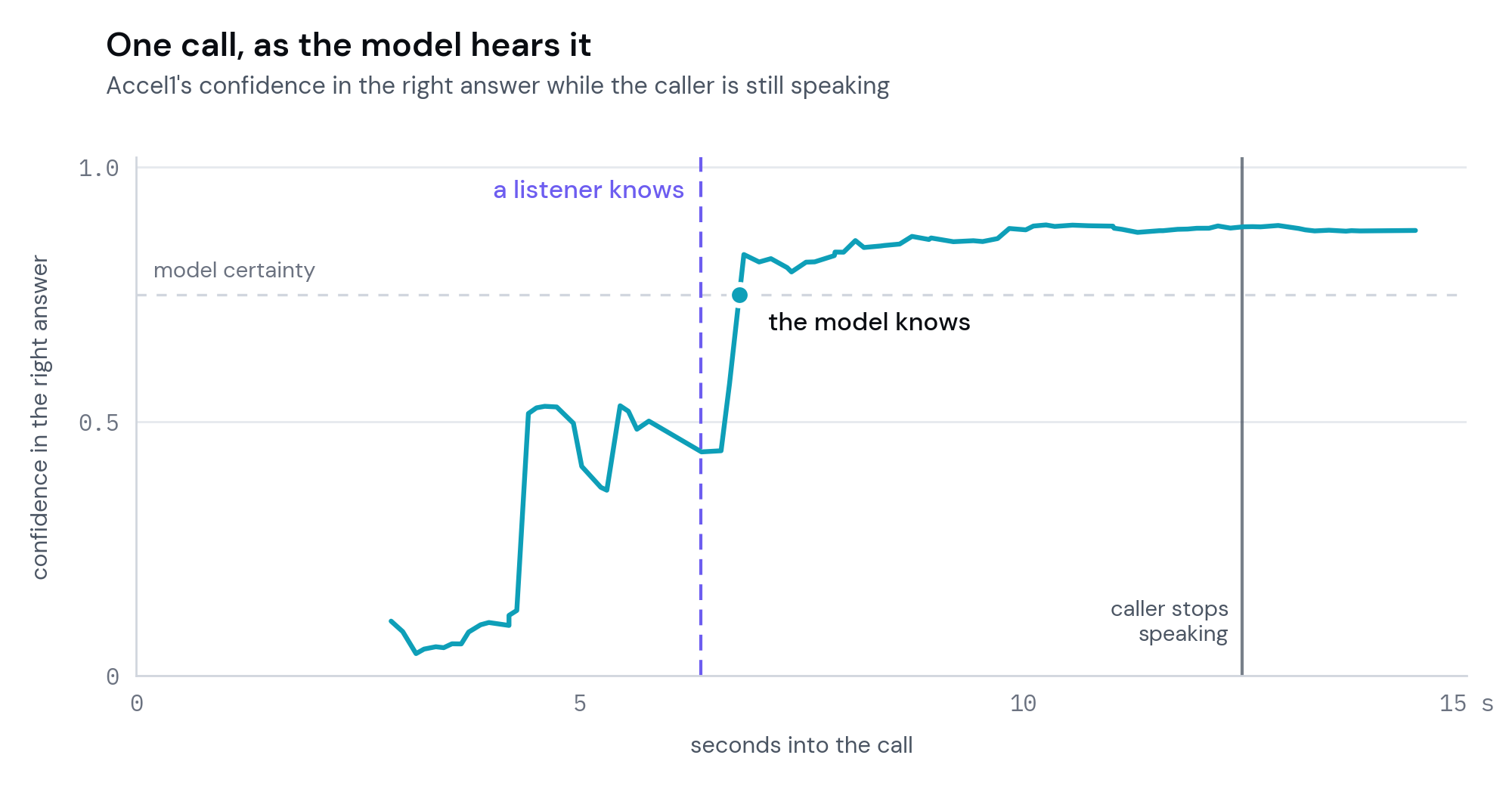
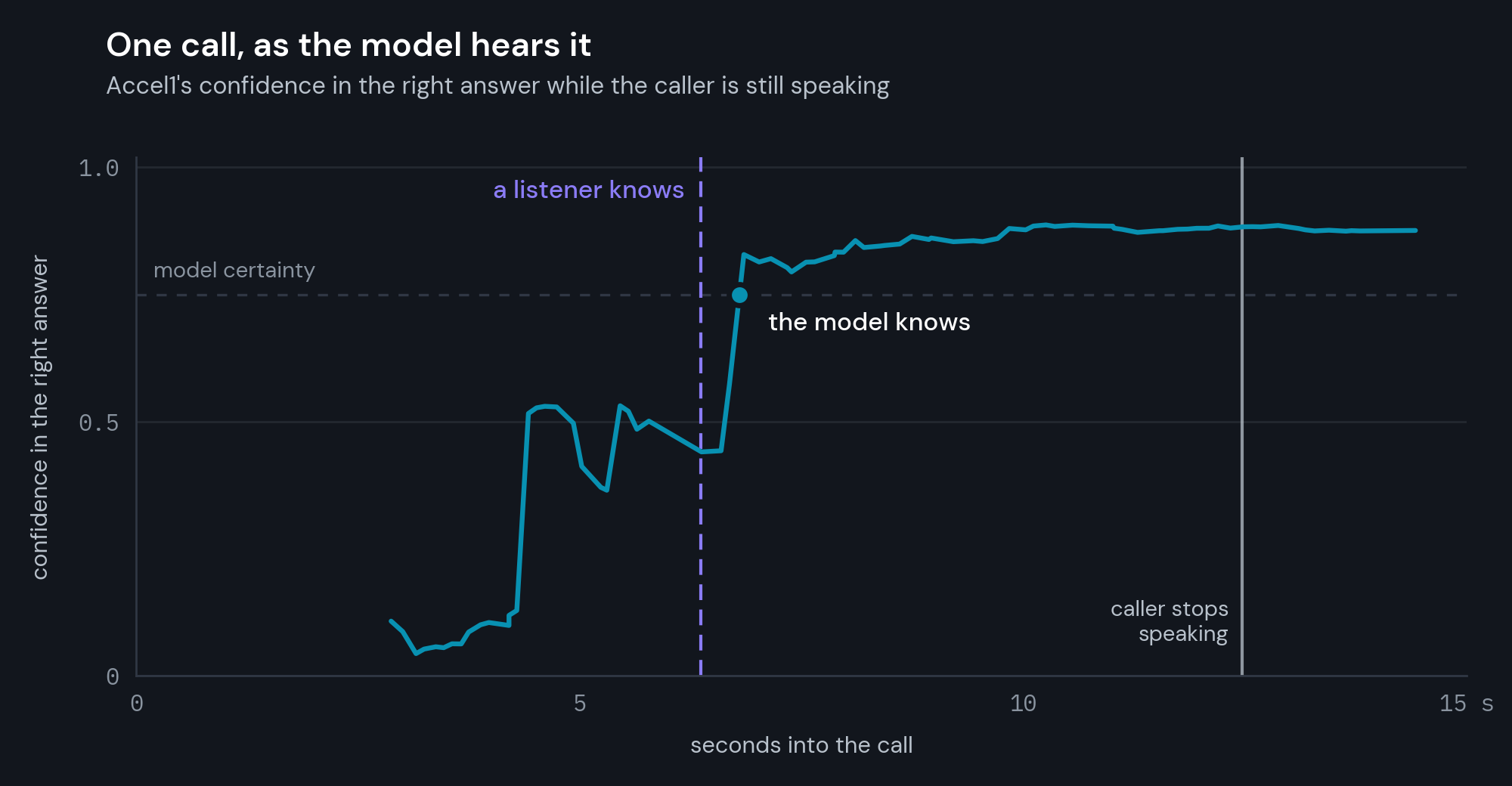
To measure how early something is, you need a point to be early against. The early-decision benchmark takes that point from people. Every item carries an annotated t0: the moment a human listener, hearing the same audio with the same options open to them, would already have enough to decide. It is the end of the earliest heard word after which the answer follows, set from the audio as it arrives rather than from a transcript read ahead, because what is being measured is perception in time, not comprehension of a finished text.
The benchmark is built on public speech corpora in nine languages: real customer calls to a contact centre, spoken assistant commands, mid-sentence corrections, and questions of emotion and intent. Each item is streamed into a live session at real-time pace, twenty milliseconds a frame, exactly as a telephone line would deliver it. The model emits a reading several times a second while the caller is still talking, so every item produces a timeline, and the timeline is read against the listener’s moment. A decision, measured this way, is a timeline, not a verdict.
What we measure
Three questions, each read off the stream of decisions the model emits while the caller is still speaking.
- Accuracy. Did the model get it right? Not only at the end, but across the readings it gave along the way.
- Timing. How early did it get it right, and how much of the turn was still to come when it did?
- Stability. Did it stay right, or did it keep changing its mind?
Each has an established measure for incremental processors, set out by Baumann, Buß and Schlangen, so these numbers can be set beside work outside our own. Task accuracy is whether the final answer matches the annotation. Relative correctness (RC) is a different question: the share of in-flight readings that agree with the model’s own eventual answer. It measures agreement with the model’s eventual prediction, not agreement with the ground truth, so it captures incremental consistency rather than accuracy. Timing is first occurrence (FO), the moment the final answer first leads, and final decision (FD), the moment after which it never moves again, both as a share of the utterance. Stability is correction time (CT), how long an answer takes to settle once it first appears, and edit overhead (EO), the share of revisions that were unnecessary.
The last two are what separate a model that has decided from one that is merely quick. A model that answers instantly and then changes its mind three times has not decided anything.
How early Accel1 decides
Four kinds of decision. The corrections are the demanding case: a caller asks for one thing and takes it back before the sentence is over.
The number to hold onto is 65 milliseconds. The +65 ms in Table 1 means that on the median contact-centre call, Accel1 reaches its stable decision 65 milliseconds after the annotated human decision point, the end of the word that decides the answer. That is not a latency figure. It is the gap between the moment a listener could first decide and the moment the model’s decision stops moving, and a median that close to zero means the model reaches its stable decision at almost exactly the moment a person first could. The spread is wide, as it should be on real calls: the middle half of those calls land between 1.6 seconds ahead of that point and half a second behind it. Across every kind of decision the median gap stays under four tenths of a second. It is the highlighted column of Table 1.
| Kind of decision | Share of the turn heard at the stable decision | Median time from human decision point to stable model decision |
|---|---|---|
| Contact-centre calls | 62% | +65 ms |
| Assistant commands | 77% | +98 ms |
| Mid-sentence corrections | 82% | +253 ms |
| Emotion and intent | 65% | +392 ms |
Table 1Per kind of decision, over the items answered correctly.
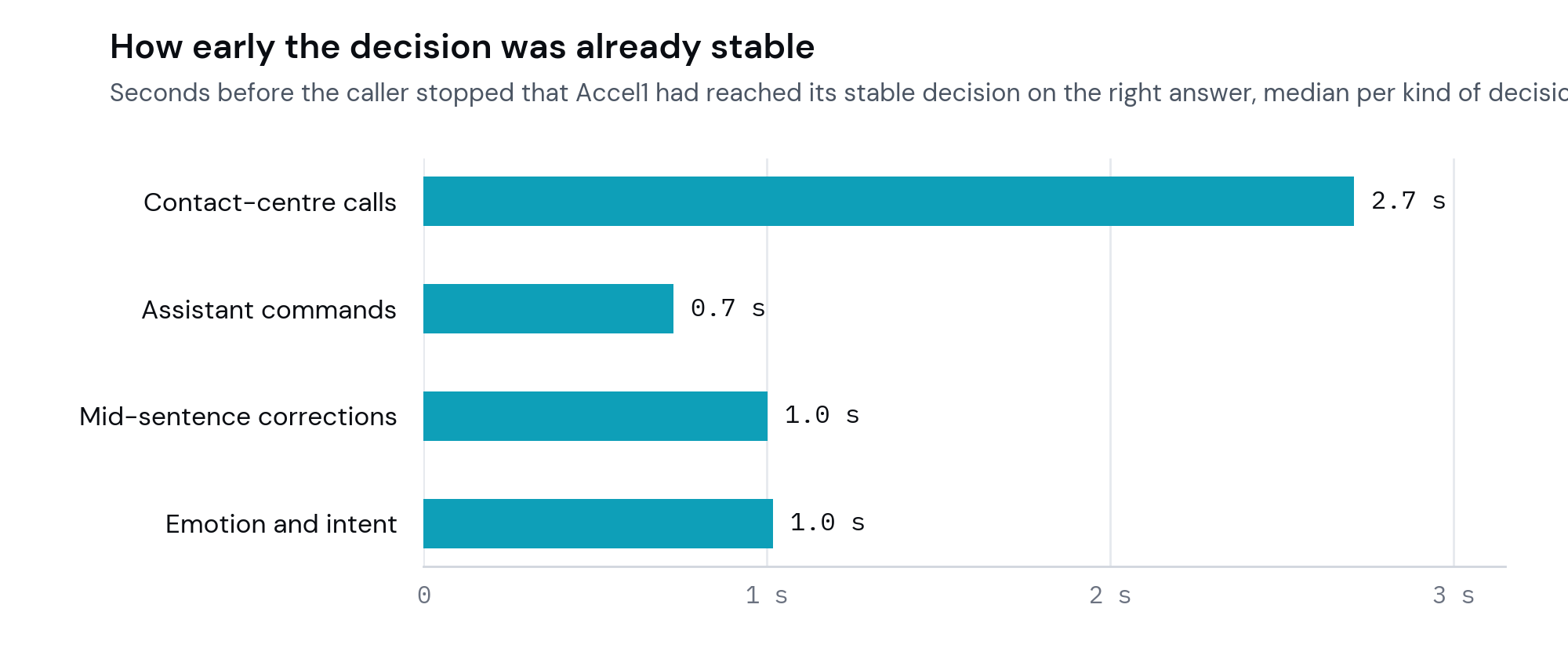
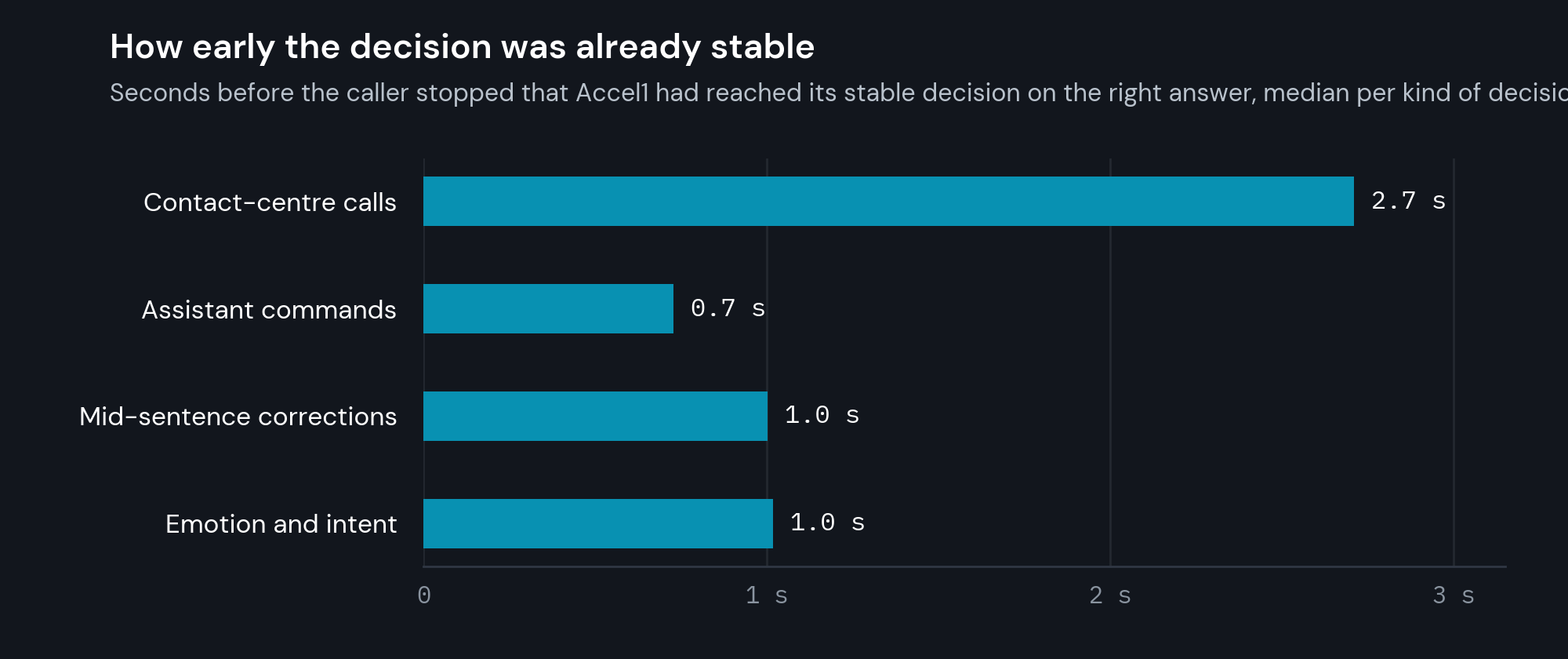
Fig. 2 shows what that earliness is worth in time. On the calls where the deciding moment arrives while the caller is still talking, Accel1’s decision is already stable a median of 2.7 seconds before they stop on real contact-centre calls, and about a second before on the rest. Across the set the decision becomes stable between three fifths and four fifths of the way through the turn.
And it turns when the speaker turns. On every mid-sentence correction, where a caller asks for one thing and takes it back before finishing, the model first follows the request and then moves with the speaker to the right one. That switch is the behaviour to want, and it is not a correction in the metric’s sense: correction time measures only whether the final answer wavers once it has appeared, and on most of these it never did. Tracking a caller who changes their mind is not the same as being unsure, and measuring stability separately from accuracy is what tells the two apart.
Where this leads
Early audio understanding changes how a voice agent operates, not only how quickly it responds. When an agent can recognise intent, retrieve relevant context, identify conversational signals and prepare actions while the caller is still speaking, those operations run in parallel rather than each waiting for the previous stage to finish. This holds whether the architecture underneath is a cascaded pipeline or a unified speech-to-speech model. Early understanding becomes an additional intelligence layer that helps the whole system operate more effectively.
The benchmark is there so this stays a measurement rather than a claim: whether a model decides, how early, and whether it stays decided.
Accel1 will be publicly available to developers soon. It is built to sit in a conversational AI stack you already run, so the decisions arrive early without rebuilding what is around them.
This is the first of a series. The next posts go deeper into the benchmark and into how we run these models in production.
Timing and stability of in-flight decisions follow Baumann, Buß & Schlangen, Evaluation and Optimisation of Incremental Processors, Dialogue & Discourse 2(1), 2011.